What the Nippo Show is and why it is different
The Nippo Show is the exhibition organised by the Nippo (Nihon Ken Hozonkai), the Japanese association for the preservation of Japan’s native dog breeds. Unlike FCI/ENCI shows, where the Shiba is judged according to the international standard, at the Nippo Show the evaluation follows the original Japanese standard — more technical, stricter and focused on the preservation of the authentic type.
The difference between the FCI and the Nippo standard
Explaining what sets the Nippo standard apart from the FCI one requires a cultural leap.
The first enormous difference compared to the FCI evaluation lies in the philosophy that pervades the Land of the Rising Sun, where the material and the spiritual must coexist in harmony. First of all, the judges look for the three pillars of the Nihon Ken in the dogs under evaluation:
Kan-i (悍威): boldness, courage and mental strength combined with great self-control.
Ryōsei (良性): good nature, loyalty and a gentle, balanced temperament.
Soboku (素朴): refined simplicity, straightforwardness and aesthetic harmony devoid of frills or excess.
The evaluation begins by carefully observing the dog’s expression and its temperament, then moves on to the purely technical assessment — and here the Nippo judging manual is applied to the letter.
I still remember when, at Padenghe, the judge crouched down and, with a pen, moved a single guard hair to assess its correct texture — the coat must have body and be firm yet still elastic: when moved, it must return spontaneously to its original position. It is a level of detail that has no equal in the world.
Beyond this, all dogs are measured, the presence of all teeth is checked and the absence of pigmentation on the mucous membranes is verified — an inspection I would go so far as to call obsessive.
Why taking part in the Nippo Show matters
Taking part in the Nippo means submitting your dogs to the harshest judgement you will ever encounter during a show career. Add to this that the Grand National is held once a year, takes place in the breed’s country of origin, is the most important event of the year and draws all the best breeders in Japan — with over 700 Shiba Inu alone entered — and you will have a fairly clear picture of what taking part means for a non-Japanese breeder.
But beyond the indisputable technical value, what is truly overwhelming is the atmosphere you breathe there.
Many breeders, especially those coming from the most distant regions, arrive the evening before, setting up a veritable village where it is possible to meet and share experiences, stories and knowledge. An air of solemnity pervades the place, and the impression is even stronger when, in the morning, the ceremony opens with the anthem and the presentation of the judges, which takes place in absolute silence, followed by applause for the draw of the rings — another striking difference: no one can know in advance by whom they will be judged.
It is not a competition open to everyone. To gain access to the Grand National in Japan, you must first qualify in one of the satellite shows organised by the Nippo in Europe and the United States. Only the dogs that pass the judgement according to the Japanese standards, earning the qualification of “Excellent” at a satellite show, obtain the pass to the mother show in Japan.
Our Nippo Show in Padenghe — 26 May 2019
On 26 May 2019, the Nippo satellite show for Europe was held in Padenghe sul Garda. It was our first time. The satellite event was organised every two years, alternating between Italy and Poland. We were very tense, given the scale of the event, but at the same time confident and proud to show the fruit of our work.
I remember that a restless night passed quickly. I got up at dawn to give the dogs their final touches and take them for a walk in the cool of the morning — partly to let them unwind and partly to try to release the tension that would not leave me. By 8:00 a.m. we were already at the showground.
That day we presented three dogs: Sensei, his half-sister Magatama (same sire) and Sensei’s daughter, Sakuia. It was an overwhelming ride. We won all the classes (categories by age group), against the best Italian and foreign breeders, and we won Best of Breed Shiba with Sensei.
This alone would have been enough to turn the day into a waking dream, but it was not over.
In the afternoon we took on the best dogs of the other Japanese breeds — Akita, Shikoku, Kishu, Kai — and claimed the absolute title as the best Japanese dog of the entire event. Our Sensei had prevailed over more than 200 of the best Japanese dogs of all breeds in Europe.
Yet the most important fact was another:
We had won as a kennel. We had presented three closely related dogs and they had all come out winning — the irrefutable proof of an exceptional breeding work.
At the Grand National in Japan — a unique record
The qualification earned in Padenghe opened the doors to the Grand National in Japan — the mother show, the most important event in the world for Japanese dog breeds.
As far as we know, we are the only kennel to have taken part in the Grand National in Japan with a dog lacking a Nippo pedigree — our Shiba are registered only with ENCI/FCI pedigrees. Presenting an “occidental” dog to the judgement of the Japanese masters was a challenge within a challenge: not just competing at the highest level, but doing so with dogs selected entirely outside Japan.
We would have liked to take part the same year, but it was not possible given the tight time available to organise everything, and we confidently postponed to the following year. Unfortunately, fate had other plans in store, and as we all know, two years of pandemic and lockdowns followed.
Without losing heart, we decided to leave as soon as possible, and in November 2022 we were finally at the airport. I will not hide that organising the trip was a real nightmare: travelling with a dog is anything but simple, what with the worry about the flight time (the dog travels in the hold), the health and customs paperwork, and the difficulty of finding accommodation that accepted animals — at the time, across all of Tokyo we found only 5 hotels willing to take Sensei.
Moreover, the show always takes place in rural areas, usually poorly served by public transport, and for this reason we also had to rent a car and drive for more than three and a half hours on Japanese roads — on the wrong side for us — but not before obtaining the international driving licence in record time.
In any case, the journey went better than expected. The direct flight from Rome saw us arrive in Tokyo all in all rested and with a great desire to discover our second “homeland”, and Sensei seemed not to have suffered the long isolation in the hold — but I was wrong.
We spent three days in Tokyo wandering the streets with no particular aim, savouring every tiny detail of a singular city. Twelve million inhabitants, yet it feels like living in a small village. The only fixed points were the visit to the statue of Hachikō in Shibuya — the Akita Inu who waited for his master at the station for nine years, symbol of the loyalty of the Japanese dog — and the wonderful little traditional restaurants.
Then came the moment to move by car to Tamura, living the thrill of a road trip that showed us the most authentic Japan. In the late afternoon we reached our accommodation, a period Japanese house with a delightful garden obsessively tended by the caretaker, whom we found busy picking up the fallen leaves one by one with a pair of steel tweezers — an experience within the experience.
The following morning, after a typical Japanese breakfast served by the hostess — a delightful little old lady of over 90 who spoke only Japanese — we decided to go to the event grounds to get information and understand how to move around, and to our surprise, already from late morning there were exhibitors busy setting up their gazebos.
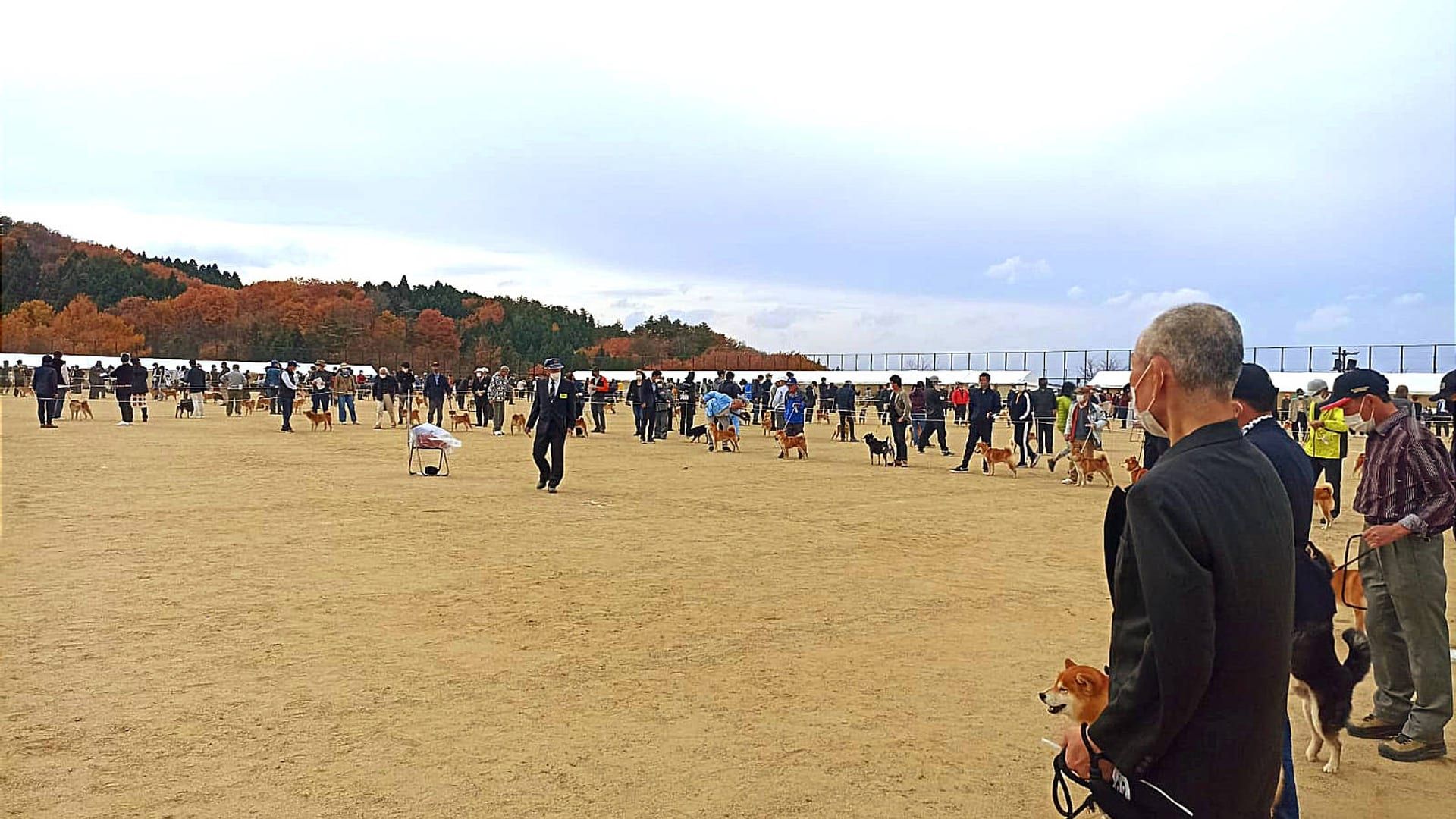
The next day we came back early; overnight everyone had arrived and it was possible to get a magnificent view of the area (a large dirt field used for all kinds of sporting events). There were now about a hundred gazebos, a multitude of people crowded every corner and, above all, there were Shiba everywhere. An unprecedented quantity that I could only describe as paradise!
We went to the secretariat to get the final information, pick up our number and some merchandise; right after, the start of the event was announced.
There was the presentation of the authorities, the greeting to the exhibitors and the draw of the judges. A small aside: for each ring there are three judges, and the final judgement is born from the comparison of all of them.
Sensei and I were ready — by now the shows had become routine — but that day was different. I felt it, and so did he. There was an air of grandeur; the event was unfolding and everyone was aware of taking part in something important. We waited about two hours for our turn. We were in a group of 43 Shiba, and the meticulousness of the evaluation took its time.
When our moment came, the judge invited us to the centre of the ring. Sensei was impeccable. Unfortunately, the journey and the change in habits had stressed him: his coat was tired and he had lost weight, eating little or nothing for three days. Even so, we did our best and earned a more than honourable 20th place, which meant that a dog born and raised in an Italian kennel had managed to place ahead of as many as 23 of the best Shiba in Japan.
A dog born and raised in an Italian kennel had managed to place ahead of as many as 23 of the best Shiba in Japan.
Once the show was over, the judge came over and, with the help of a person who knew a bit of English, asked me where the dog came from. He was greatly astonished when he understood that it was not a Japanese dog. He complimented me on Sensei and explained that, due to inexperience, I had made some mistakes during the presentation — the way of presenting a dog at the Nippo is different from the one used in the rest of the world — which had probably worsened the final placement.
But it matters little. We had proved that by working with method, knowledge and dedication it was possible to get where many could only dream.
What the Nippo Show means for those who choose a puppy
For a future owner, knowing that their puppy comes from a kennel that has competed at the level of the best Japanese dogs, and that can boast a selection valid both according to the extremely strict Nippo canons and according to the FCI/ENCI standard, is a further guarantee of quality and authenticity — a unique duality that, as far as we know, belongs only to Shinjukawa. If you want to see the dogs and results we are talking about, read how morphology and function meet in the Shiba standard and why every one of our breeding dogs is a champion. Our available puppies come from these lines.