Morphology, function and the laws of the Shogun's Dog — how history shaped Japanese dogs
In modern cynology there is a fundamental principle: form follows function. Every physical and behavioural trait of a dog is not an aesthetic whim — it is the result of centuries of selection dictated by the work that dog had to perform. In Japanese dogs, this principle takes on a particular depth: the size, the independence of character, the silence, the agility are not random traits. They are the product of a unique environment — the Japanese mountains — of specific hunting techniques, and of a historical period in which the laws of a Shōgun known as “the Dog” and the social restrictions on hunting created the conditions for dogs with certain characteristics — first behavioural, then physical — to have a selective advantage over others.
Form follows function — but it is different for the Shiba
“Form follows function” is a principle that cynology borrowed from architecture. The idea is simple: if a dog was selected to run, it will have long legs and a deep chest (the greyhound); if it was selected to dig, it will have short legs and an elongated body (the dachshund); if it was selected to pull sleds, it will have heavy bone and powerful musculature (the Malamute).
But applying this principle to the Shiba requires a crucial distinction. The Shiba was not “selected” in the modern sense of the term — no breeding programme, no written standard, no pedigree. As we saw in the article on the three original populations, the ancestors of the Shiba were ji-inu — village dogs, landraces shaped by geographic isolation and natural selection. The “function” that shaped them was not decided by a breeder but by the environment in which they lived and the work they did: hunting in the Japanese mountain undergrowth.
This is why the Nippo standard does not prescribe how the Shiba “should be” — it describes how the Shiba is. The three fundamental concepts of the standard — kan-i, ryōsei and soboku — are not goals to be achieved but photographs of a dog moulded by centuries of function.
Kan-i, ryōsei, soboku — the photograph of the Japanese dog
The Nippo standard defines the essence of the Nihon Ken — of the Japanese dog in general, not of a single breed — through three concepts that have no direct equivalent in Western languages. They apply to all six Nihon Ken: from the Shiba to the Akita, from the Kishu to the Shikoku. They are the common denominator of dogs that differ in size and specialisation, but share an origin and a character forged by the same environment.
Kan-i (悍威) — bold spirit. It is not aggression: it is the quiet determination of a dog that does not back away from danger, but does not seek confrontation either. It is the dog that keeps a wild boar at bay without attacking it head-on, that holds its position without giving ground, that faces the unknown with calm and courage. A hunter in the Japanese mountains needed a dog with kan-i — a dog that did not flee but did not get itself killed needlessly either.
Ryōsei (良性) — balanced temperament. It is the ability to “switch on and off” the hunting instinct: fierce in the hunt, docile at home. The dog that barks furiously at the wild boar in the woods and then lies quietly by the fire in the evening. As Shigeru Kato wrote: “a good hunting dog helps you bring home the meat, stays out of trouble, and helps you hunt safely. This dog switches on in the mountains, but is just as comfortable switching off at home, curling up in front of the fireplace.” Anyone who owns a Shiba today recognises this description immediately.
Soboku (素朴) — natural beauty, not artificial. It is the opposite of the groomed, brushed Western show dog, built to impress. Soboku is the beauty of raw wood, of unpolished stone — a beauty that comes from function, not from decoration. The Shiba does not have to “look” beautiful: it has to be beautiful because it is built well, because every trait has a reason.
These three concepts were not invented by Nippo in 1928. They are the codification of qualities that hunting selected for over centuries — qualities that existed in the mountain ji-inu long before anyone put them in writing. The standard photographed the dog; it did not draw it.
Japan before the Shogun’s Dog — hunting in the mountains
To understand how function shaped the form of the Shiba, one has to imagine rural Japan in the 16th-17th centuries.
The Japanese mountains — steep, densely forested, with undergrowth thick with low bamboo and shrubs — required a hunting dog with very specific characteristics. Not a large dog like the European molossers (which did not exist in Japan before the 17th century), not a pack hound like the Western scenthounds, but a small, agile dog capable of moving silently through the undergrowth, working autonomously with a single hunter, and carrying out different tasks depending on the prey.
The hunting techniques documented for small and medium-sized dogs were specialised by type of game:
Nagashi-ryō (流し猟) — the matagi hunt. The hunter and the dog worked as a pair, often alone, covering miles through the mountains. The dog stayed near the hunter, regularly checking his position, and reacted only to fresh scent (hot nose). When it found the prey, it flushed it and held it at bay until the hunter arrived. This technique selected for operational independence (the dog decides how to move through the terrain), long-distance collaboration (stays in contact with the hunter without the need for continuous commands), and controlled courage (holds the prey without getting killed).
Ageki-ryō (揚げ猟) — pheasant hunting. The dog penetrated the mountain undergrowth to flush the pheasants and make them take flight, giving the hunter the shot. This technique required small size (to slip through the low vegetation), silence in the approach (so as not to send the prey fleeing before being in position), and explosiveness at the moment of the flush — the instant the dog springs forward and forces the bird into the air.
Yobiyose-ryō (呼び寄せ猟) — duck hunting with a decoy. The dog attracted the ducks towards the hunter — the name itself means “to call towards oneself”. This technique required intelligence, self-control and the ability to work indirectly. The hunters lured the ducks towards a bottleneck at the end of which the trap was placed, while the dogs had to cut off the escape routes and retrieve the animals that escaped the ambush, hidden among the reeds.
Ōkami-ryō (狼猟) — “circle” hunting (or the wolf pack tactic). The pack of dogs fanned out to surround the large game (wild boar), preventing its escape — imitating the strategy of a wolf pack. This technique required the combined action of Seko-ken (勢子犬, driving dogs) for the chase and Tome-ken (止め犬, stopping dogs) for the engagement and close-quarters blocking of the prey. For reasons of strength and temperament, this method was the prerogative of medium and large-sized dogs (such as Kishu, Shikoku and Kai), less so of the small dogs.
Each technique selected for specific traits. But the common denominator was clear: what was needed was a small, silent, independent, agile dog, courageous without being reckless, able to collaborate with a single hunter without needing constant direction. Not an executor of orders — a partner.
Siebold’s Kari Inu — the photograph of the proto-Shiba
The most important historical confirmation of what these dogs were like comes from an unexpected source: a German physician.
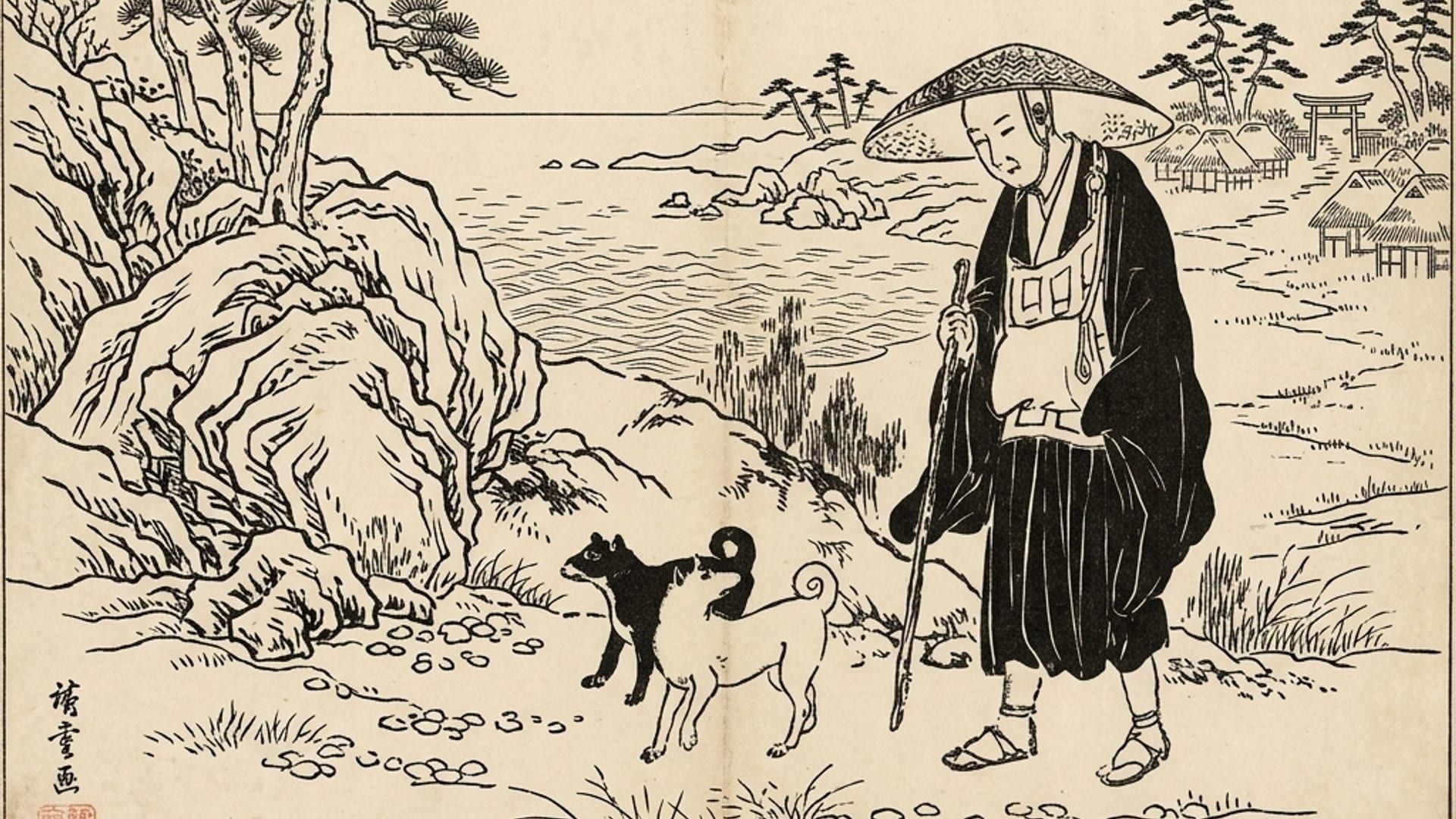
Philipp Franz von Siebold (1796-1866) lived in Japan during the Edo period and gathered extraordinary documentation of Japanese fauna, flora and culture. In his work Fauna Japonica (1842) and in the manuscripts kept in the archives (in particular Ms 16820 and Ms 13388), Siebold described the Kari Inu — the Japanese “hunting dog” — as a lively, docile dog with slender bone structure and a small, well-formed head, erect ears and a curled tail.
In manuscript Ms 16820, the Kari Inu is defined as “Wachthund (shuken)” — guard dog — and Siebold considered it the only truly native dog of Japan. The measurements in manuscript Ms 13388 show a dog very similar in size to the modern Shiba, slightly taller, but in the same size range.
As Dr. Holger Funk concluded in his research work on the origins of the Shiba: “I am convinced that the Shiba of today is a descendant of a local variety of the Kari Inu as Siebold described it.” The dog that Japanese hunters used for ageki-ryō and yobiyose-ryō is, in all likelihood, the direct ancestor of the Shiba we know today.
The Shogun’s Dog — when the law changed everything
Into this context — small dogs, undergrowth hunting, specialised techniques — burst one of the most singular events in Japanese history.
Tokugawa Tsunayoshi (1646-1709) is one of the most fascinating, controversial and radical figures in the whole history of feudal Japan: the fifth Shōgun of the Tokugawa dynasty, he went down in history as Inu-Kubō (犬公方) — the “Shōgun’s Dog”. He issued several edicts known as Shōrui Awaremi no Rei (生類憐みの令, “Edicts of compassion for living beings”). Initially aimed at protecting abandoned babies and the sick, the edicts were progressively extended to all animals (horses, birds, fish, even insects), but the highest protection was reserved for dogs. Strict hunting restrictions were introduced, falconry (Takagari 鷹狩) was abolished, while hunting large pests such as wolves, bears and wild boar remained the exclusive prerogative of the Daimyō (feudal lords) and samurai, who cited the defence of land and crops as their justification. The rest of the population was left only with hunting aquatic or migratory birds, but had to obtain a seasonal licence and register every single kill.
The effect on dog selection
Tsunayoshi’s edicts, and the pre-existing restrictions on hunting for the non-aristocratic classes, created a unique environment that profoundly influenced the selection of hunting dogs.
Already before Tsunayoshi, the German physician Engelbert Kaempfer, who visited Japan in 1690, had observed: “Greyhounds and water dogs do not exist; for hunting, for which there is not much opportunity, ordinary dogs are used.” Hunting was already limited for the common people — there was no European tradition of grand aristocratic hunts with packs of hounds. Hunting was a solitary activity or one carried out in small groups, in the mountains, with one or two dogs.
Tsunayoshi’s edicts made this scenario even more restrictive. With falconry banned and severe penalties for mistreating dogs, the number of mountain hunters — who depended on hunting for their livelihood — who practised poaching increased. In a context where discretion was a necessary choice, a dog that barked loudly and drew attention was a risk, a large dog that consumed too much food was a luxury, an aggressive dog that wounded the game needlessly was a waste.
The selective pressure then intensified in the direction that already existed: small dogs (less visible, less expensive to keep), silent ones (in approaching the prey and in not drawing unwanted attention), independent ones (capable of working without constant direction in a context where the hunter had to be as discreet as possible), and intelligent ones (capable of using tactics rather than brute force).
Sakoku and genetic isolation
Another historical factor played a decisive, albeit indirect, role: Sakoku (鎖国) — the policy of closing Japan off from the outside world.
From 1635, under Shōgun Tokugawa Iemitsu (third of the dynasty), through a series of edicts known as the Sakoku-rei, Japan closed almost all of its borders for more than two centuries.
For dogs, this meant total genetic isolation. No foreign breed could enter the country (the shōgun’s imports of large European dogs were rare exceptions, limited to the court). Japanese dogs bred among themselves for more than two hundred years without any external contamination — an isolation that consolidated and fixed the traits that functional selection had produced.
Sakoku did not create the Shiba — it preserved it. While in Europe breeds were being crossed, redesigned, created from scratch to satisfy changing fashions and functions, in Japan the dogs remained what they had always been: small mountain hunting dogs, moulded by environment and function, with no outside influences.
It was only after Japan reopened in the Meiji era (1868) that Western breeds began to arrive and cross with the native dogs — a process that within a few decades brought the pure Japanese breeds to the brink of extinction and prompted the founding of Nippo in 1928.
From function to form — the circle closes
The Shiba we see today is the result of this unique history:
The small size is not an aesthetic affectation — it is the adaptation to centuries of hunting in the mountain undergrowth where a large dog could not move, and to a social context in which keeping a large dog was an impossible luxury for a mountain hunter.
The independence of character — that trait every Shiba owner knows well — is not stubbornness: it is the legacy of generations of dogs that had to make autonomous decisions in the woods, without waiting for commands from the hunter.
The silence — the Shiba is not a dog that barks at nothing — comes from selection for approach hunting (ageki-ryō, yobiyose-ryō), where a noisy dog made the prey flee. And it probably intensified during the period of Tsunayoshi’s edicts, when drawing attention was risky.
The agility and the athletic yet compact structure come from the Japanese mountain terrain — steep slopes, dense undergrowth, unstable ground — where a heavy or clumsy dog was a disadvantage.
The courage without recklessness — the kan-i of the standard — comes from the need to keep game at bay without getting killed: a dog that attacked a wild boar head-on died young and did not reproduce.
And the natural beauty — the soboku — is simply what happens when a dog is perfectly adapted to its function: it needs no decoration because every trait has a reason.
The Nippo standard did not invent these qualities — it recognised them, named them and preserved them. Kan-i, ryōsei and soboku are not prescriptions: they are the photograph of a dog that the history, geography and laws of Japan shaped in an unrepeatable way.
If you want to see how this selection takes shape, read the results achieved at the Grand National and why every one of our breeding dogs is a champion. Our available puppies come from breeding dogs selected for morphology and function.
References
- Dr. Holger Funk. “Der Urtyp des Shiba” / “The Original Type of the Shiba.” shiba-dog.de — In-depth research on the origins of the Shiba, with analysis of Siebold’s manuscripts.
- Siebold, Philipp Franz von (1842). Fauna Japonica. — Description of the Kari Inu. Manuscripts Ms 16820 and Ms 13388 in the Siebold archives.
- Kaempfer, Engelbert (1690). Observations on Japan. — Note on the absence of greyhounds and water dogs and on the restrictions on hunting.
- Nippon.com. “Japanese Perceptions of Life.” — Tsunayoshi’s 135 edicts (Shōrui Awaremi no Rei, 1685-1709), the world’s first animal welfare legislation.
- Nihon Ken Hozonkai (NIPPO). Standard of the Nihon Ken — Definition of kan-i, ryōsei, soboku.
- Nihonken.co / Shigeru Kato. “Hunting and the Nihon Ken” — Nagashi-ryō and modern hunting techniques.
- Shibainubreeders.jp. “The Hunting Instinct of Japanese Dog” — Shigei Ryozen (姿芸両全) and Ryōnō (猟能).
- Boomlayshibas.com. “Ōkami no Bourei” — Ōkami-ryō and the bond between the Japanese dog and the wolf.