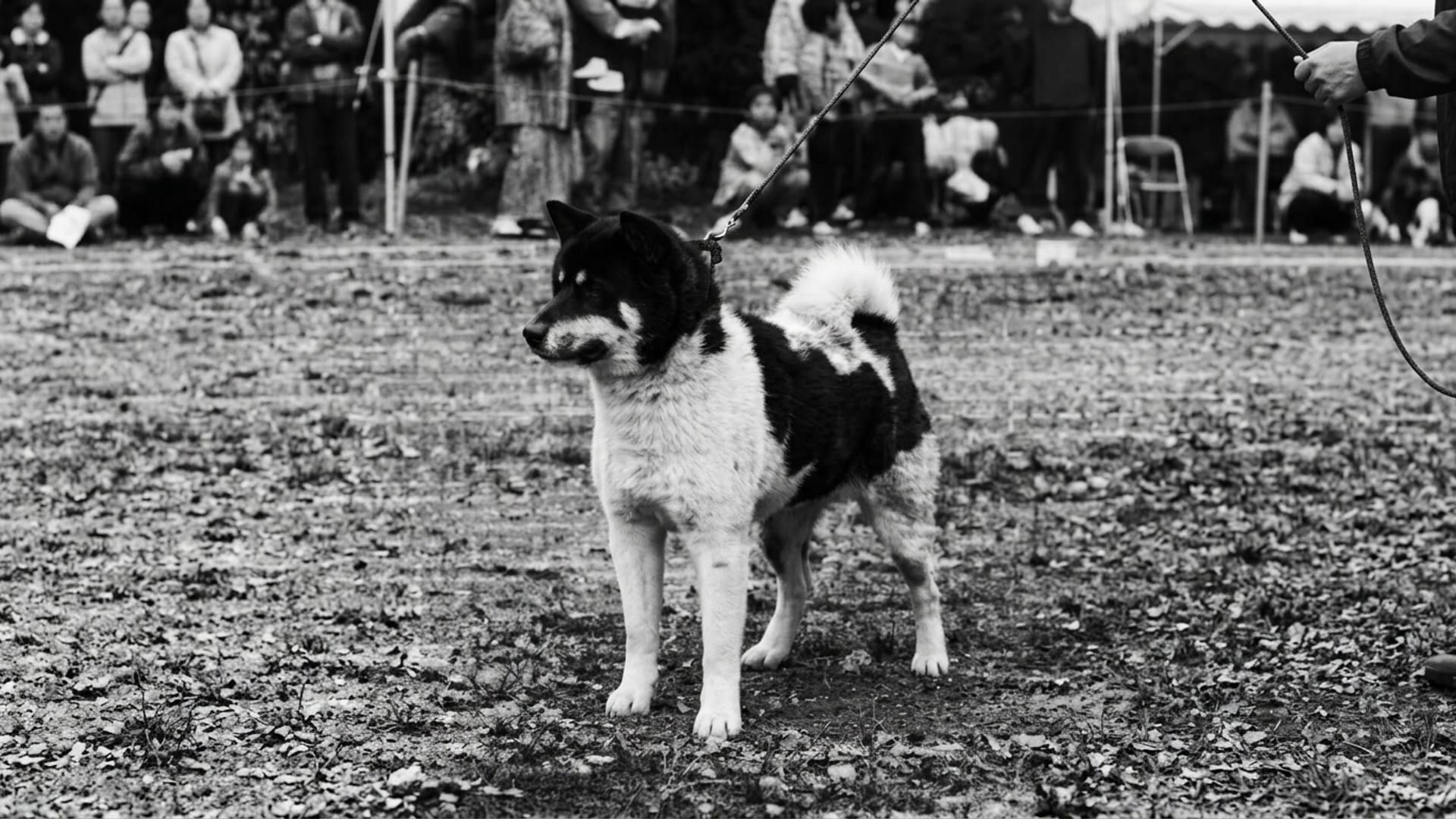
The Pinto mystery in the Shiba Inu — genetics, history and how to spot it
Every now and then, one comes across a Shiba with evident asymmetric white patches where it should not have them — a piebald or Pinto. For the Nippo standard it is a fault to be penalised, and yet at times it appears without any apparent reason. It is a known problem in the breed, but preventing it is not as simple as it seems. While for other breeds a simple DNA test is enough, it has been discovered that these are ineffective for the Japanese breeds. Behind this mystery there is a fascinating story that begins in postwar Japan, an off-standard dog that saved the breed from extinction, and an allele that travels silently through the pedigrees of thousands of Shiba around the world.
When the DNA test lies
If you have ever frequented the rings of dog shows or the groups of Shiba Inu enthusiasts, you will certainly have heard of the Pinto coat — the one with asymmetric white patches on the body, neck or head. The answer you hear most often is: “that dog is a carrier, a DNA test of the parents before the mating would have been enough to avoid it.” The breeder’s fault.
But genetics, when it meets the ancient Japanese breeds, decides to do as it pleases. Studies conducted by major international canine genomics laboratories, such as MyDogDNA and Wisdom Panel, have lifted the veil on a real problem: the tests commonly used for white and pinto often give unreliable results on the Shiba Inu — or rather, the result of the test (the DNA) does not correspond to the expected phenotype (the appearance of the dog).
To understand the reasons for this problem we must take a step back. The pigmentation of a dog’s coat is the work of certain cells, the melanocytes — the cells that produce melanin, the same one that tans us in summer. Their development in the neural crest of the embryo, the subsequent migration towards the skin, follicles, mucous membranes and retina, their survival once arrived at their destination, and the activation of the enzymes that synthesise melanin depend on a gene called MITF (Microphthalmia-associated Transcription Factor). This gene can present itself in two variants (alleles): S and sp. The first is fully functional; the second is an “attenuated” version, in which a mutation — typically the insertion of a SINE element in the promoter of the gene — reduces the expression of the MITF protein.
MITF — Microphthalmia-associated Transcription Factor. This is the gene that regulates the development of melanocytes — the cells that produce melanin — and their migration towards the skin, follicles and mucous membranes in the embryo. It has two alleles: S (functional) and sp (attenuated). When a dog is sp/sp, MITF protein production is reduced and the migration of melanocytes is incomplete: some areas of the body lack pigmentation. That is the mechanism behind pinto.
What is, in simple words, a SINE insertion? SINE elements (Short Interspersed Nuclear Elements) are short “mobile” DNA sequences, capable of copying themselves and inserting themselves at different points of the genome over the course of generations — a bit like a fragment of text that duplicates and pastes itself elsewhere by mistake during transcription. When one of these fragments ends up by chance exactly in the “promoter” of a gene — the region that regulates how much and when that gene is activated — it can disturb its functioning without destroying it entirely: the MITF gene remains present and partially operative, but produces less protein than normal. This is exactly the mechanism behind the sp allele: not a “broken” gene, but a gene “partially silenced” by an unexpected guest that has settled in its command region.
And here is where the laboratories’ results became inexplicable. The geneticists who analyse samples at a global level realised they had results that defied the laws of biology:
The ghost Pinto: dogs that tested sp/sp — genetically predisposed to be piebald — presented themselves as perfect, without the shadow of a misplaced white patch.
The mysterious patch: on the contrary, Shiba with evident high white socks or patches on the chest and body tested genetically S/S, i.e. completely lacking the piebald allele.
How to explain it?
The textbook genetics — that does not apply to the Shiba
In most dog breeds in the world, the white “patchy” colour (piebald or pinto) is regulated by the MITF gene, positioned on the so-called S Locus, with the allelic variants S and sp.
In the DNA we can therefore have the combinations: S/S, S/sp and sp/sp.
The variants S/S and S/sp — dog without pinto and dog carrying pinto — will give uniform coats: the presence of a single sp allele does not attenuate the S variant sufficiently, so MITF carries out its function correctly, the melanocytes colonise the entire organism and the coat is uniformly coloured. When instead we have the sp/sp variant, MITF’s function is compromised, and the migration of the melanocytes is incomplete: some areas show an absence of pigmentation, the famous white patches or spots. This is the piebald — not a “white colour”, but an absence of pigmented cells.
On paper, preventing the Pinto would be simple: if both parents are S/S, piebald puppies will never be born. But in the Shiba Inu and other Japanese breeds this rule does not work — and the reason lies in the extraordinary history of these breeds.
The Shiba is a primitive breed, isolated for centuries on the mountains of Japan, separated from the Western dog stock before modern genetic mutations stabilised. Scientists have discovered that the expression of white in Japanese dogs does not depend only on the main switch (the MITF gene), but on “shadow” regulatory regions and unique mutations that the current standard tests are not yet able to read. In practice, the laboratories use a lens calibrated on European dogs, which does not see the unique variants of Japanese DNA.
The ugly dog that saved the breed — the story of Korotama Go
To understand why the pinto allele spread in the modern Shiba, one must return to post-Second World War Japan.
The breed risked total extinction. The bombings and a devastating epidemic of distemper decimated its population. The few survivors were mated intensively, focusing almost exclusively on the bloodline of the very famous stud Naka Go, the founder of the Shinshu line — one of the three original lines from which the modern Shiba Inu descends. This very strong consanguinity was leading to the genetic collapse of the breed.
It was then that it was decided to introduce Korotama Go Hakkakusou (コロ玉号 白鶴荘). Son of Korokoma Go Kineisou — whose father Koroaka Go Soutarousou had been Best in Show at the Nippo Grand National of 1958 — and of Mari Go, a bitch native to the mountains of Ehime in the Shikoku region. A dog with a paternal pedigree of the highest quality and very fresh maternal blood, coming from lines never touched by the consanguinity of the postwar reconstruction.
There was, however, a big problem: Korotama Go was a black-and-tan Pinto, aesthetically off-standard, a dog that should not have reproduced and that at a show would have been penalised without appeal.
But his blood was too precious to be discarded. His coefficient of inbreeding was 0% — in technical terms a radical outcross that brought the desperately needed genetic diversity. He was used as a sire despite his appearance, and produced at least two known offspring: Michime Go Inoguchi and Tamahime Go Yorokobisou (born on 28 February 1966), both in turn parents of further descendants.
Those descendants carried the pinto allele with them as a hidden recessive trait. As said, in heterozygous form (S/sp), the allele is invisible: the dog appears perfectly solid-coloured, but is a silent carrier. Two carriers need to meet for the pinto to re-emerge — and this can happen generations later, when no one by then remembers the story of Korotama Go.
The tragic irony is that the dog that helped save the breed from genetic collapse is probably also the main source of the pinto allele that today occasionally appears in litters all over the world. The price of survival.
The manifestations of the pinto — the optical illusion
Everyone expects to recognise a piebald or pinto at first glance, but it is not so. The pinto can also present itself in a subtle way, confusing itself with the Urajiro — a desirable and typical characteristic of the breed.
What is Urajiro
Urajiro is the white-cream pattern that frames the muzzle, the cheeks, the chest, the belly and the inner part of the Shiba’s legs. It is an essential characteristic of the breed, defined precisely by the Nippo standard.
A fundamental detail that many do not know: Urajiro is not made of white hairs, but of hairs with extremely faded pigment — cream, almost transparent. It is regulated by genes linked to the intensity of the pigment (I Locus), completely different from the piebald allele (S Locus). Urajiro and Pinto are two distinct genetic phenomena that have nothing in common — but to the eye they can seem similar.
Where Urajiro is allowed — the boundaries of the standard
The Nippo standard defines precisely the areas where Urajiro is accepted:
- On the muzzle and cheeks, excluding the nasal bridge
- Under the lower jaw and the lower part of the neck
- On the chest up to the shoulder joint - no further
- On the abdomen and inside the hind legs
- On the forelegs up to the elbow, on the hind legs up to the knee
- On the lower part and the tip of the tail
The standard adds an important note: the excessive expansion of the white must be prevented. And the reverse mask — white on the nasal bridge extending from the upper edge of the eyes onto the cheeks — is to be penalised as undesirable.
The standard adds an important note: the excessive expansion of the white must be prevented. And the reverse mask — white on the nasal bridge extending from the upper edge of the eyes onto the cheeks — is explicitly penalised as undesirable.
How to distinguish them by sight — the rule of transition
The difference between a correct Urajiro and a hidden Pinto piebald marking is subtle but unequivocal, once you know what to look at. The key is in the transition between the light area and the adjacent coloured area.
A correct Urajiro always has a shaded and gradual transition. The hair does not pass abruptly from coloured to white: it lightens progressively, like a watercolour that loses intensity. The boundary between the light area and the coloured one is soft, diffuse, without a clean line. This is because the mechanism is a gradual reduction of the pigment intensity — the hair is always pigmented, only ever less so.
Pinto piebald markings present a clean break. The hair passes from coloured to genuinely white — not faded, truly lacking pigment — with a defined margin, a visible break where the colour ends and the white begins. There is no gradualness, no shading. It is a boundary, not a transition. This is because the mechanism is different: it is not a reduction of pigment, it is a total absence of melanocytes in that area — the cells that produce colour never arrived there during embryonic development.
The practical rule: every time one observes a clean break between a white area and a coloured area — even within the Urajiro itself, a white “sock” with a defined edge, a patch with precise contours — it is a strong alarm bell of hidden piebald marking. This is exactly the kind of information that genetic tests cannot provide reliably on the Shiba, and that only the experienced eye of a breeder who knows the phenomenon can evaluate.
Inside the mouth — the knowledge handed down by old Japanese breeders
There is a traditional Japanese practice that to a modern observer might seem like superstition: the old breeders, when evaluating a dog, also inspect the inside of the mouth, looking for chromatic anomalies on the mucous membranes — tongue, gums, palate. While the Nippo standard lists the dark patches on the tongue (zeppan) among the aesthetic defects, admitting for the Shiba only a patch no larger than the fingertip of a little finger, the clinical eye of the historic experts sought a much more subtle biological indicator: the intensity and uniformity of the pink and dark pigmentation. It is not superstition — it is embryonic developmental biology, observed empirically centuries before science explained it. The melanocytes are not born in the skin. They form in the neural crest of the embryo and then migrate towards their final destination: the hair follicles, the skin and the oral mucous membranes. The MITF gene coordinates the survival and distribution of these cells, but the final quality of the colour depends on a delicate polygenic balance. When the melanocyte system is strong and stable, the pigmentation saturates not only the outer coat, but colonises in a rich and homogeneous way also the deeper internal tissues. And here is the crucial point: the oral mucous membranes act as a litmus test for the dog’s “genetic robustness”. A specimen with an apparently correct coat, but showing a faded tongue, depigmented lips, unusually pale mucous membranes or, on the contrary, excessively dark or blackish ones, reveals a latent weakness in the production or maintenance of melanin, or a massive and latent presence of eumelanin (the black pigment). The Shiba’s mouth is an internal chromatic map that reveals to the expert breeder exactly how much “black strength” or “red strength” the dog carries in its DNA even before breeding. Inspecting the mouth thus allowed the ancient masters to evaluate the real pigmentary load of the subject, selecting for reproduction only the genetically most solid dogs and avoiding the progressive “fading” or the appearance of Sashige (差し毛). The latter is that “dirty” or “impure” red hair, characterised by a diffuse and disordered presence of hairs with a black tip (black tippings) along the body, particularly on the back and the tail.
Tradition and science, here, converge: the old breeders observed empirically what developmental biology explained later. The mucous membranes are a window onto the distribution of the melanocytes in the entire organism — not only in the coat.
What it means for selection
This genetic complexity radically changes the approach to breed selection. It tells us three things:
DNA tests are not a magic wand. A genetic report that defines a Shiba as “pinto carrier” (S/sp) or “clear” (S/S) must be interpreted with extreme caution — it could be a false positive or a false negative. Science is still trying to map the “occult modifiers” of the Nihon Ken DNA.
Knowledge of bloodlines is sovereign. Since the tests are not 100% reliable on the Shiba, the direct observation of parents, grandparents and great-grandparents — their coat, their Urajiro-colour transitions, the presence or absence of patches on the mucous membranes — remains the most reliable tool for a breeder. It is not a return to the past: it is the recognition that on this breed, technology has not yet reached the empirical knowledge accumulated in centuries of observation.
The eye counts more than the laboratory. The rule of the shaded transition (Urajiro) against the clean break (pinto), the inspection of the mucous membranes, the genealogical memory of the lines — these are tools that no test can replace. A breeder who has known his lines for generations knows where the allele might hide, which matings to avoid, and how to read the signs that the coat and the mucous membranes reveal.
The Shiba Inu confirms itself, once again, as a breed that jealously guards its genetic secrets — challenging the most advanced laboratories in the world and reminding us that behind every puppy there is a story written in a code that modern science is only beginning to decipher.
Coat colour is only one of the many traits a breeder must learn to read: see the puppies available and meet the breeders behind Shinjukawa.
References
- Standard Nippo (Nihon Ken Standard & Commentary), updated spring 2024 — nihonken-hozonkai.or.jp
- Karlsson E.K. et al. (2007). “Efficient mapping of Mendelian traits in dogs through genome-wide association.” Nature Genetics, 39, 1321–1328. — Study that identified the candidate mutations in the MITF-M promoter associated with white piebald markings in dogs.
- Schmutz S.M., Berryere T.G. (2007). “The genetics of cream coat color in dogs.” Journal of Heredity, 98, 544–548.
- Schmutz S.M. et al. (2009). “MITF and White Spotting in Dogs: A Population Study.” Journal of Heredity, 100(suppl 1), S66–S74. — Study on 324 dogs of 45 breeds confirming the association between the SINE insertion in the MITF-M promoter and the piebald/extreme white phenotypes, documenting also the exceptions.
- Körberg I.B. et al. (2014). “A Simple Repeat Polymorphism in the MITF-M Promoter Is a Key Regulator of White Spotting in Dogs.” PLOS ONE, 9(8), e104363. — Key study demonstrating how no single mutation is sufficient to explain the piebald marking: the phenotype is the result of the combination of multiple polymorphisms in the MITF-M promoter, including alleles shared with wolves.
- Brancalion L. et al. (2022). “Canine coat pigmentation genetics: a review.” Animal Genetics, 53, 3–34. — Complete review documenting the influence of modifier genes on the variability of the white phenotype across different breeds.
- Genealogical database: shibapedigree.com — record of Korotama Go Hakkakusou (id: 63615)