Shinshu, Mino and San'in — the three populations behind every Shiba Inu
Before the Second World War, “the Shiba Inu” as we know it today did not exist. There were three regional populations of hunting dogs, each shaped by centuries of geographic isolation in the Japanese mountains: the Shinshu from Nagano Prefecture, the Mino from Gifu Prefecture, and the San’in from the prefectures of Tottori and Shimane. They were not breeds raised according to a programme: they were landraces — local populations made uniform by the environment, not by the hand of man. It was only in the twentieth century that Japanese scholars recognised them, classified them, and after the breed’s near-extinction in the postwar period fused them into a single standardised breed — the modern Shiba Inu.
Local dogs, not breeding breeds
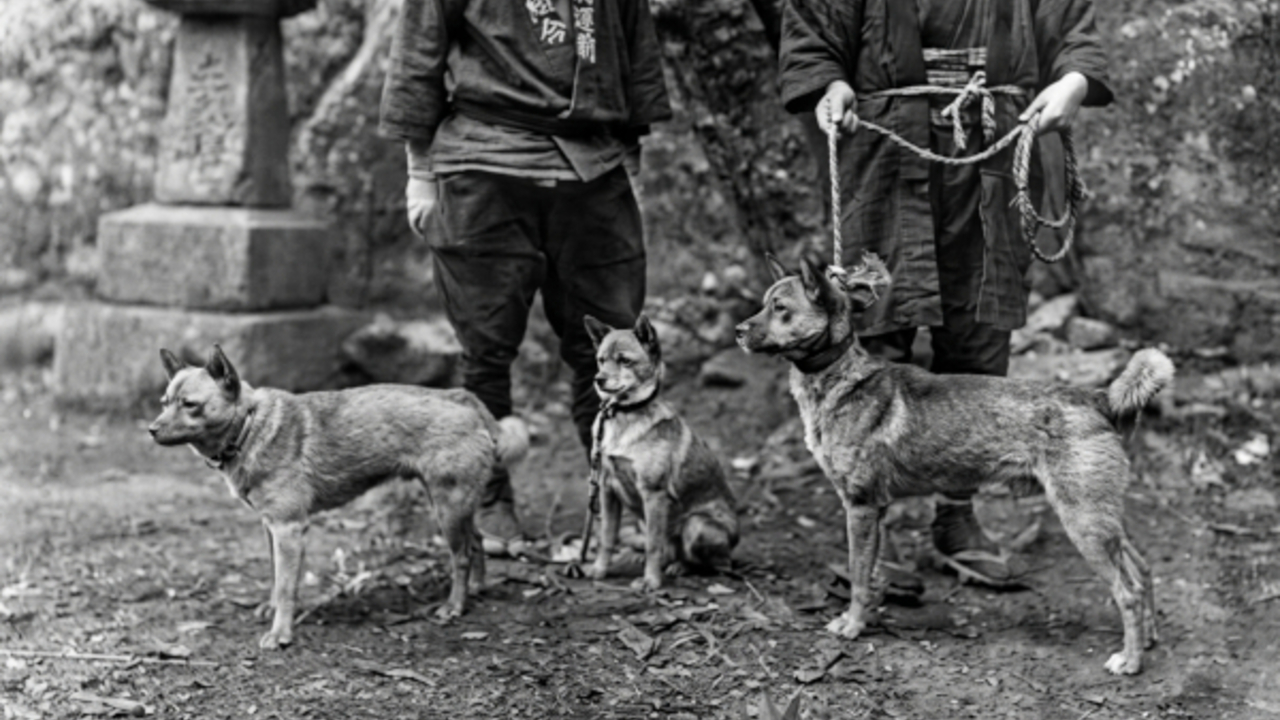
For centuries, in the mountain valleys of Japan, hunters and farmers kept small, agile dogs for hunting small game and birds in the undergrowth. No one “selected” these dogs in the modern sense of the term — no breeding programme, no written standard, no pedigree. They were 地犬 (ji-inu), literally “dogs of the place”: they mated among themselves within the same area, the mountains acting as a natural barrier, and over time each local population became homogeneous.
The selection that did exist was not intentional but functional: the hunter kept the dog that hunted well, that withstood the cold, that did not fall ill. The least suitable dogs died or were not kept. It is selection, but it is environmental and practical selection — very different from the targeted work on morphology and temperament that modern dog fancying practises today.
The result was that anyone travelling from the north-east to central Japan encountered visibly different dogs — larger or smaller, deep red or black and tan, with curled or sickle tails, with or without the clear lightening on the belly. They were all “Shiba” — small hunting dogs of the mountains — but they were three distinct populations with their own characteristics, each shaped by its own environment.
The Shinshu — the dogs of Nagano
The dogs we today call Shinshu came from Nagano Prefecture, in the heart of the Japanese Alps. They were the smallest and most compact of the three populations, with a solid, dense undercoat — an adaptation to the harsh climate of the high mountains — and a thick guard coat. Unlike the modern Shiba, they had round rather than triangular eyes, and carried their tail in a sickle rather than in the characteristic curled tail.
The Shinshu is the population that contributed most to the modern Shiba, for a reason as practical as it is tragic: it was the variety with the greatest number of survivors after the war. While Mino and San’in were almost completely wiped out, more Shinshu survived in the isolated mountain villages of Nagano — protected precisely by that geographic isolation that had made them a distinct population.
It is from the Shinshu line that Naka Go descends, the dog commonly considered the father of the modern Shiba and founder of the celebrated Akaishi line. But his genealogy holds a surprise.
Naka Go — the father of the modern Shiba who was not Shinshu
The official story tells that the postwar reconstruction of the Shiba was based predominantly on the Shinshu line. It is true, but it is incomplete.
The genealogy of Naka Go, documented by the Nippo itself, reveals that the “founder” of the modern Shiba was in fact the son of crosses between different populations:
His most celebrated ancestor is Ishi Go, a Sekishu Ken — a dog of the San’in region — discovered in 1936 in Masuda City, in Shimane Prefecture. The Nippo defines him as “the father of the modern Shiba Inu” — and it is no exaggeration, because the entire reconstruction of the breed descends from him.
Ishi Go was mated with Koro Go, a bitch from Shikoku — another island, blood completely external to the three populations. From this cross was born Aka Go. Aka Go was then mated with Hana Go from Tottori (San’in blood), producing Beniko Go, and separately with Meigetsu Go, a ji-inu — a local village bitch, with no registered pedigree — producing Akani Go.
From Akani Go and Beniko Go was born Naka Go.
What does this genealogy tell us? That Naka Go carried San’in blood (Ishi Go from Shimane, Hana Go from Tottori), Shikoku blood (Koro Go), and the blood of unregistered local dogs (Meigetsu Go). He was “Shinshu” by virtue of the place where he lived and was bred, but his DNA was already a cross of the different native Japanese populations. The purity of the “Shinshu line” is, from the very origins, a myth — the fusion had already begun before the war.
Naka Go died on 23 December 1963. His genetic heritage is present, according to estimates, in 80% of modern Shiba Inu. From him descends the Akaishi line, and from that, through the celebrated Hakuba No Gen (born from a father-daughter mating that concentrated the founder lines), the Gen line — whose grandson Azumi No Take won Best in Show at the Nippo Grand National of 1984.
The Mino — the mahogany of Gifu
The dogs of Gifu Prefecture, in central Japan, were immediately recognisable for three characteristics that distinguished them sharply from the Shinshu.
The colour was an intense, deep mahogany — a red far darker and more saturated than that of the modern Shiba, which the Japanese call “Hi-Aka” (fire red — or flame red). Ironically, that colour that defined the Mino is considered a fault in the modern Shiba, where a brighter, more luminous red is preferred.
The eyes were deep brown and rectangular in shape — not triangular as in the current standard — and the ears were thick and “fleshy”, different from the thin, pointed ears of today’s Shiba.
But the most significant trait was the absence of the urajiro — the white-cream lightening on muzzle, chest and belly that today we consider an essential trait of the Shiba. The Mino did not have it. This detail says a great deal: the urajiro that today we consider “typical of the breed” comes predominantly from the Shinshu population, not from the other two.
The Mino has its own separate register and a few specimens are occasionally presented at Nippo shows for educational purposes, but the Nippo does not recognise it as a distinct breed. As a pure population it is considered extinct — its genetic heritage lives on in the traits it passed to the modern Shiba.
The San’in — the great black of the north-east
The dogs of the prefectures of Tottori and Shimane, in the north-eastern region of the main island, were the largest of the three populations — significantly bigger than the modern Shiba — with an appearance and a temperament that set them markedly apart from the other two.
The predominant colour was black and tan — a commonly dark coat, at times piebald. Like the Mino, the San’in had no urajiro. It did, however, have a well-defined stop (the indentation between forehead and muzzle) that is found in the modern Shiba — one of its most recognisable legacies.
The temperament was decidedly more fiery and independent than that of the other two — a characteristic that, according to many, has passed into the modern Shiba and defines its unmistakable character. Recent DNA analyses have suggested genetic connections with the Korean Jindo, which would make geographic sense: the prefectures of Tottori and Shimane overlook the Sea of Japan, facing the Korean peninsula.
The San’in is also the population of Ishi Go — the dog from which Naka Go descends and, through him, nearly all modern Shiba. The paradox is evident: the population that gave the breed its genetic founder is also the one about which least is known and of which fewest traces remain as a distinct variety.
The discovery, the catastrophe, the fusion
In the 1920s, Japanese dog fancying began to organise itself. In 1928 the Nippo (Nihon Ken Hozonkai) was founded with the aim of preserving native dog breeds from crossing with the Western breeds, increasingly widespread after the opening of Japan during the Meiji era. In 1936, the Shiba was designated a “Natural Monument” — a protection that recognised its cultural value.
For the first time, someone looked at these village dogs not as hunting tools but as heritage to be preserved. Three scholars each devoted themselves to one of the three populations: Masuzo Ozaki studied the San’in, Tatsuo Nakajo the Shinshu, and Masayu Ishikawa the Mino. The project was ambitious: to document, protect and preserve the three varieties as distinct heritages.
The war erased that project in a few years. The bombings, the famine and the epidemic of distemper that followed decimated the Japanese dog population. Mino and San’in were reduced to a very few specimens. Only the Shinshu survived in sufficient numbers — but “sufficient” is a relative term: even the Shinshu was on the brink of extinction.
There was no longer the luxury of preserving three separate populations. The few survivors of the three varieties were crossed with one another — Shinshu with San’in, San’in with Mino — to save what could be saved. Genetic diversity was so reduced that even dogs like Korotama Go Hakkakusou, a black-and-tan pinto aesthetically off-standard but with a coefficient of inbreeding of 0%, was used as a sire because his fresh blood was too precious to be discarded.
From this forced fusion was born the modern Shiba Inu — a dog that is neither Shinshu, nor Mino, nor San’in, but the product of their union. The modern standard, written on the basis of this new reality, took predominantly from the Shinshu (size, undercoat, urajiro) but incorporated traits of the other two populations (the defined stop of the San’in, the robustness of the Mino).
From village dogs to a worldwide breed
The history of the Shiba Inu is a story of transformation: from village dogs without name or pedigree, shaped by the mountain and by necessity, to a breed recognised and protected as a natural monument, to a nearly extinct breed, to a breed recreated from the fusion of survivors, to one of the most popular breeds in the world.
The traits of the three original populations still emerge today. An experienced breeder recognises the different influences in the specimens he produces: a particularly deep and saturated red evokes the Mino; a more robust structure and a pronounced stop recall the San’in; the compactness, the dense undercoat and the well-defined urajiro are Shinshu heritage.
Knowing this history is not an academic exercise — it is a tool. Those who breed Shiba Inu today work with a genetic heritage that carries within it the marks of three different populations, a near-extinction, forced crosses among survivors, and eighty years of modern selection that has tried to harmonise all of this into a single standard. Every puppy born carries within it the traces of this history — it is up to the breeder to know how to read them.
Our selection method is born precisely from this awareness: learn who we are and how we breed and see the available puppies.
If you want to follow this path up to today, read how the modern Shiba Inu lines have changed and how function shaped form in the Shiba standard.
References
- Nihon Ken Hozonkai (NIPPO). “History of the Shiba Inu.” nihonken-hozonkai.or.jp/en/history/ — official genealogy of Naka Go and of the founder dogs.
- Genealogical database: shibapedigree.com
- National Purebred Dog Day. “Mino, San’in, and Shinshu” and “The Four Shibas.” nationalpurebreddogday.com — characteristics of the three original varieties.
- Temple-Okami. “L’histoire moderne du Shiba Inu.” temple-okami.com — details on the Gen line and Hakuba No Gen.
- Nippo standard (Nihon Ken Standard & Commentary), updated spring 2024 — nihonken-hozonkai.or.jp