The four founder lines of the modern Shiba Inu
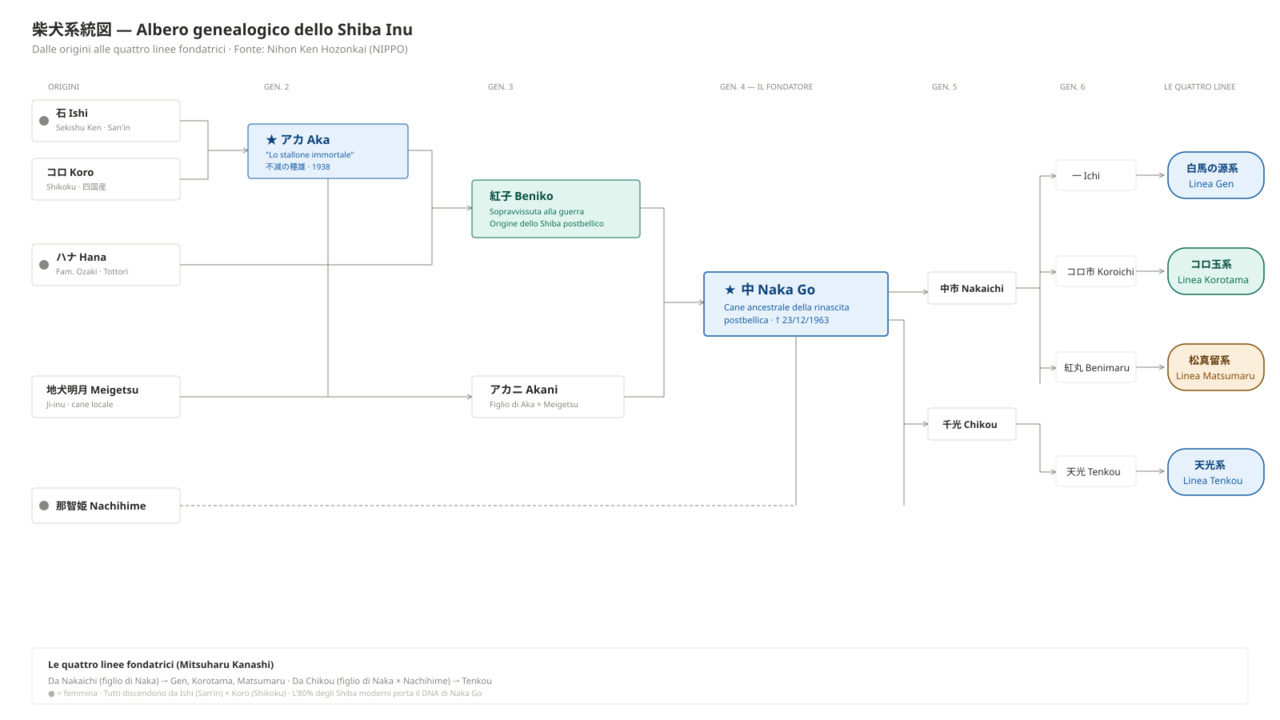
Every Shiba Inu alive today can be traced back, through its pedigree, to four founder lines identified by Mitsuharu Kanashi — a judge of the Nippo (Nihon Ken Hozonkai) and one of the association’s reference figures, with encyclopaedic knowledge of the breed’s genealogies. Kanashi identified four studs around which, in the postwar period, the reconstruction of the Shiba after its near-extinction crystallised: Gen, Korotama (Ichisuke), Tenkou and Matsumaru. Several decades have passed since his analysis, and new lines have meanwhile established themselves, but the fundamental structure remains: most modern Shiba carry in their pedigree the name of at least one of these four dogs.
Why only four
After the Second World War, the Shiba was reduced to a few survivors. As we recounted in the article on the three original populations, the reconstruction of the breed was a process of forced fusion among the few remaining dogs — Shinshu, Mino, San’in and even off-standard dogs like Korotama Go, the black-and-tan pinto used as a radical outcross.
From that extremely restricted gene pool there emerged, within a few generations, some exceptional studs that were used intensively as sires. Their best offspring were selected, and the offspring of the offspring after them — until the traits of those founders stabilised into recognisable lines. It is the classic mechanism of bloodline formation: an exceptional dog imprints his genetic mark on his descendants, and that mark becomes the “type” of the line.
The fact that there are only four reflects the reality of the postwar genetic bottleneck: the base was so restricted that few studs dominated the reconstruction. All modern Shiba are, in a sense, cousins.
The Gen line — Hakuba No Gen Go Roukakusou
The Gen line is considered the most influential of the four. Its founder, Hakuba No Gen Go Roukakusou (白馬の源号 郎鶴荘), was born on 9 September 1970. He was a red male, Nippo-registered under number 99422.
His genealogy says a great deal about the reconstruction strategy of the era. Hakuba No Gen was born from a father-daughter mating: Kojirou Go Garyuusou mated with Matsumari Go Roukakusou, who was the daughter of Kojirou himself. An extreme inbreeding (COI of 25%) that concentrated the traits of the founder lines into a single subject — exactly the diagnostic technique we discuss in the article on bloodlines.
The result was a dog that fixed a recognisable type and transmitted it to his descendants with extraordinary consistency. Hakuba No Gen’s grandson, Azumi No Take, won Best in Show at the Nippo Grand National of 1984 — confirmation that the line had reached and surpassed the level of the best Japanese dogs.
The Gen line branched out through the various sons and grandsons of Hakuba No Gen, each of whom opened his own branch. It is the dominant line in the modern Shiba — whoever opens the pedigree of any Shiba and goes back far enough will, with very high probability, find Hakuba No Gen.
The Korotama/Ichisuke line — from the pinto to glory
The story of this line is the most fascinating of the four, because it begins with a paradox: its founder was an off-standard dog.
Korotama Go Hakkakusou (コロ玉号 白鶴荘) — the black-and-tan pinto that we recounted in detail in the dedicated article — was introduced as a radical outcross to save the breed from genetic collapse. His COI was 0%, the maximum possible diversity. The price was the introduction of the pinto allele into the population.
The line took the alternative name “Ichisuke” from the descendant Ichisuke Go, through whom Korotama’s best traits — genetic diversity, robustness, vigour — were concentrated and refined by progressively eliminating the aesthetic fault of the piebald markings.
The Korotama/Ichisuke line then developed into two main branches:
Beniryu/Jouji — a branch that carries the names of its principal founders.
Fukuryu/Toyonishiki — the most celebrated branch, whose leading exponent is Toyonishiki of Toyohashi Onoda. Toyonishiki won Best in Show at the Nippo Grand National of 1987 and is considered by many Japanese scholars “the true and excellent heir” of the Korotama line — the maximum harmonious expression of all the qualities sought by Japanese masters in the Shiba.
The importance of this line is such that the Japanese renamed the original “Ichisuke/Korotama” line with the names of its two most illustrious branches: Beniryu/Jouji and Fukuryu/Toyonishiki.
It is through the Fukuryu/Toyonishiki line that the Japanese Shiba arrived in the Western world in a significant way. The first European and American kennels that imported subjects from Japan worked predominantly on this line.
The Tenkou line — Tenko Go Jonenso
The founder of the Tenkou line is Tenko Go Jonenso (天光号), a dog linebred on Naka Go. As the Nippo family tree reveals, Tenko is the son of Chikou — the second son of Naka Go, born from the mating with Nachihime — and therefore represents a different genealogical branch from that of the other three lines, which all descend from Nakaichi (Naka’s other son).
Tenko’s breeder was Kenpei Ishikawa, one of the most influential figures in the history of the Shiba — he had already bred before the war and was among the founders of the Nagano district as a centre of breed selection.
Tenko did not have a particularly brilliant show career: he was missing some premolars, an hereditary fault consequent to the extreme inbreeding of the postwar period. Despite this limitation, he won several times in regional shows and placed three times in the main one. But his importance lies in his descendants: he was the father of Yu Hime and Tenryu, both winners of the Prime Minister’s prize (BIS) at Nippo shows. In total, eleven of the best dogs of his period descend directly from him.
His coat was described as “red like the sun” — very similar to the original colour of the classic Shiba.
Tenko’s maternal grandmother, Mari, came from Korodama — a well-known black&tan piebald dog from Shikoku. This detail links the Tenkou line to the Korotama line through Shikoku blood, and explains why Kanashi speaks of four “predominant” but not “separate” lines: they are branches of the same tree that continuously interweave.
The Tenkou line was also one of the first to be exported from Japan to the Western world — it was the one that, more than any other, brought the Shiba to Europe and America.
The Matsumaru line — Matsumaru Go Shinshu Nakajimaso
Matsumaru Go Shinshu Nakajimaso (松真留号) was a red male, from the Nagano district. His name appears in the Nippo family tree as a descendant of Benimaru — son of Nakaichi, grandson of Naka Go — confirming his place in the Nakaichi branch together with the Gen and Korotama lines.
Matsumaru was the father of an extraordinary number of winning puppies. His daughter Maruhime won the Prime Minister’s prize (BIS) at the main Nippo show on 15 November 1970, and a year and a half later Matsumaru himself won the same prize — an extremely rare case of father and daughter both winning the highest recognition of the Nippo.
In the 1950s and 1960s, the Nagano district produced an impressive number of winning dogs, and it was largely thanks to Matsumaru and his descendants. The victories of Matsumaru and Maruhime brought Nagano back to its historical position as the main centre for Shiba selection — the same position the prefecture had held before the war as the heart of the Shinshu line.
Matsumaru died in 1979.
Beyond the four — other fundamental studs
Kanashi’s analysis focuses on the four main lines, but the document “Shibans Historia” — based on “The Shiba Journal” by Yuko Salvadori — documents other studs that had a determining influence on the breed in the 1960s and 1970s.
Meiho Go Shimamura — inbred on Naka and Nakaichi, younger brother of the celebrated Fuji Nishiki. Meiho was famous for a rare characteristic in the postwar period: a perfect and complete dentition. In an era in which tooth loss and malocclusion were endemic problems in the breed — a direct consequence of extreme inbreeding — having a sire with impeccable dentition was a precious genetic advantage. One of his sons won the Prime Minister’s prize, and Meiho himself was inbred on Naka and Nakaichi, carrying an extremely high concentration of the founder’s traits.
Hideyoshi Go Shinshu Kirinso — red, born in 1960. He was the first Shiba from Kyushu to win the Prime Minister’s prize — a notable fact because until then the winners came almost exclusively from the Nagano district. Judge Watanabe wrote of him: “This dog expresses a natural dignity… The expression is typical and genuine, the proportions are harmonious, the coat texture is excellent and the colour ideal.” Hideyoshi’s victory demonstrated that the quality of the breed was spreading beyond the historical heart of Nagano.
The new lines — evolution continues
Kanashi himself specified that several decades have passed since his analysis and that “many new lines have meanwhile established themselves”. When a particularly influential stud emerges from one of the founder lines, he can give rise to a sub-line that over time acquires its own identity — with a recognisable “type” and characteristics distinct from the mother line.
The two branches of the Korotama/Ichisuke line — Beniryu/Jouji and Fukuryu/Toyonishiki — are the most documented example: born as sub-lines, they acquired such relevance as to be considered lines in their own right by Japanese breeders.
This process is continuous and does not stop. Every generation can produce a subject capable of imprinting its mark on a new line — provided it is recognised, valued and used methodically. This is the work of breeding: not to undergo the genetic heritage but to shape it consciously, generation after generation.
The limit of the sources — and why research continues
Thanks to the document “Shibans Historia” — a series published in Shiba-Nytt and based on “The Shiba Journal” by Yuko Salvadori — and the official family tree of the Nippo, today we can document in detail all four founder lines and the main postwar studs. But the history of the lines does not stop in the 1970s.
The documentation on subsequent generations — how the lines evolved from the 1980s to today, which new studs opened new branches, how the world population differentiated — lives predominantly in the Nippo stud book, which is neither digitised nor accessible to the public, and in the oral knowledge that circulates among Japanese breeders during events and reciprocal visits.
It is one of the reasons why direct participation in the Grand National and personal contact with Japanese breeders is so precious: it is often the only way to access knowledge that does not exist in accessible written form.
Why it matters for those choosing a puppy
Knowing the founder lines is not an academic exercise — it is a practical tool. When a breeder tells you “my dogs come from the Gen line” or “I work on the Fukuryu/Toyonishiki line”, he is communicating precise information about which traits to expect, what kind of dog it produces, and how deeply he knows the genealogy of his subjects.
A breeder who can place his own dogs within the framework of the founder lines demonstrates a knowledge that goes beyond the single pedigree — it is an understanding of the breed as a whole, of its history and its genetic structure. And when that breeder can also tell you how his lines connect to the founders and which choices he has made to maintain or evolve them, you are talking to someone who breeds with method, not to someone who mates dogs at random hoping for a result.
If you want to see how these lines feed into the Shinjukawa selection, you can read the article on the founding lines of our kennel, meet the breeders and see the available puppies and the waiting list.
References
- Kanashi M. — Nippo judge, analysis of the founder lines of the Shiba Inu. Cited in Hoshi No Tama Shiba (hoshinotama-shiba.com/history).
- Salvadori Y. “Shibans Historia” (Del 1-5), The Shiba Journal. Translated into Swedish by Christen Lang for Shiba-Nytt, then by Annika Mårtensson. — Main source for the biographies of the founder dogs.
- Nihon Ken Hozonkai (NIPPO). 柴犬系統図 — Official family tree of the Shiba Inu, from the origins to the four lines.
- Haskett G., Houser S. (2003). “The Total Shiba.” Alpine Publications, Loveland, Colorado.
- Atsumi N. “A Journey beyond Shiba II.” yokohamaatsumi.the-ninja.jp
- Genealogical database: shibapedigree.com — records of Hakuba No Gen Go Roukakusou (id: 63600), Korotama Go Hakkakusou (id: 63615).