Was sesame the Shiba Inu's original colour? What evolutionary genetics says
Sesame — the coat with hairs in alternating bands of light and dark pigment — is the rarest and most mysterious colour of the Shiba Inu. Many enthusiasts instinctively assume it is also the oldest: after all, it is the “wolf” pattern, the one of wild canids. But evolutionary genetics tells a far more surprising story. Thanks to the study by Bannasch and colleagues published in 2021 in Nature Ecology & Evolution, we know that the oldest colour in canids is not sesame — it is yellow/red, shared with the white Arctic wolves and originating from an extinct canid more than 2 million years ago.
The question that seems obvious
Anyone with a basic knowledge of canine colour genetics knows that the agouti wild type allele (aw) — the one that produces alternating bands of eumelanin and pheomelanin on every single hair — is called “wild type” for a reason: it is the pattern of wild canids. Modern grey wolves, coyotes, jackals — all of them have the agouti coat, the colour of those that live in the wild and need camouflage.
The Shiba Inu is one of the most primitive dog breeds, whose ancestors remained isolated in the Japanese mountains for centuries. If agouti is the “original” colour of wild canids, and the Shiba is a primitive breed, then sesame — the expression of agouti in the Shiba standard — should be its oldest colour.
Logical. But wrong.
Two million years before the wolf
In 2021, an international team led by Danika Bannasch (University of California, Davis) published in Nature Ecology & Evolution a study that rewrote the evolutionary history of colour in canids.
The researchers discovered that the ASIP gene — the same gene responsible for sesame in the Shiba — is not controlled by a single mutation but by two independent regulatory modules: the ventral promoter (VP), which controls the colour of the underbody, and the hair cycle promoter (HCP), which produces the dorsal pattern. The different combinations of the variants of these two promoters produce five distinct colour patterns in dogs: dominant yellow, shaded yellow, agouti, black saddle and black back.
The surprise came from the phylogenetic analysis. The haplotype (group of alleles) of dominant yellow — the predominantly yellow/red pattern, the one of Golden Retrievers and yellow Labradors, for instance — is not a recent creation of human selection. It is shared with the white Arctic wolves of Ellesmere Island and Greenland, and its origin traces back to an extinct canid that diverged from the grey wolf during the Pleistocene, more than 2 million years ago.
In other words: the yellow/red colour in dogs is older than the grey wolf itself. It did not arise from domestication — it was already there, in a common ancestor, millions of years before the first humans domesticated the first dog.
And agouti? Isn’t it the oldest?
Agouti (sesame) is indeed the most common pattern in modern grey wolves — but “most common today” does not mean “oldest”.
The Bannasch study shows that the colour of modern wolves (agouti, with a banded back and light belly) is the result of a specific combination of promoters (VP2 + HCP2) that became fixed in the grey wolf. But the HCP1 variant — the one that produces dominant yellow — is phylogenetically older: it comes from an evolutionary branch that diverged before the modern grey wolf took shape.
The evolutionary picture is therefore this: about 2 million years ago, an ancestral canid already carried HCP1 (dominant yellow). From that strain the branch that gave rise to the grey wolf split off, in which HCP2 (agouti) became predominant. When the first dogs were domesticated from wolves, they carried both variants with them — and human (and natural) selection then distributed the patterns differently across the various breeds and populations.
What it means for the Shiba Inu
In the Shiba, the four colours recognised by the standard — red, sesame, black and tan, and white (cream) — represent four different combinations of the ASIP promoters:
-
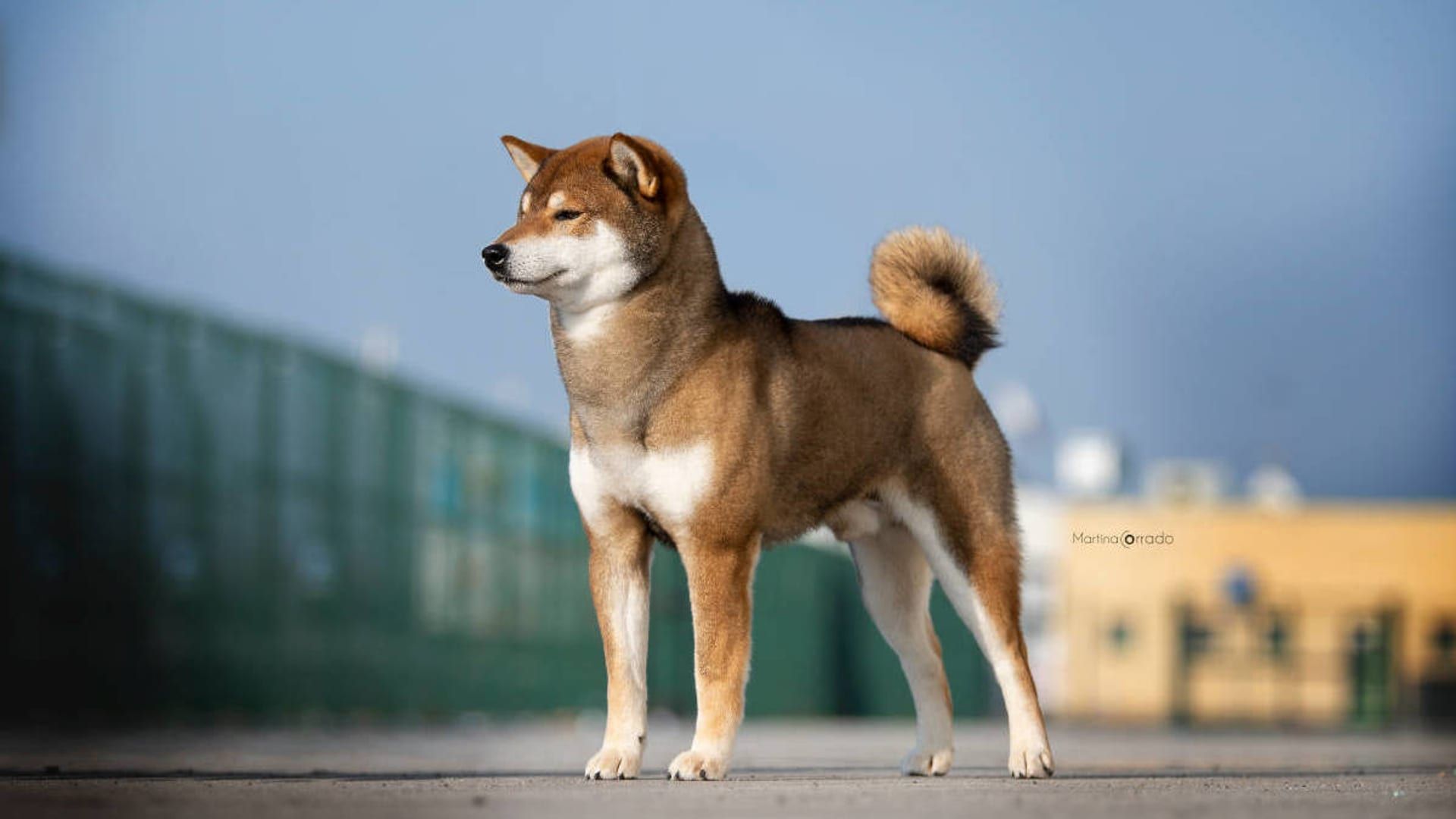
Red is the dominant colour of the breed. Genetically, red Shibas carry the Ay gene, in its various combinations with Ays, Aw and At, combinations that produce a predominantly red coat with, at most, localised black hairs or a slight “shadow” on the tips. The Shiba red is a version of dominant yellow/shaded yellow — the oldest pattern of all, the one dating back 2 million years.
-
Sesame (in its sesame, red sesame and black sesame variants) is the expression of agouti in different shades. Classic sesame, with alternating lighter and darker bands, corresponds to the agouti wild type pattern aw/aw or aw/at — the colour of the modern grey wolf. Red sesame, as we explored in the article on the genetic research our kennel contributed to, is the ays/ays or ays/at combination: one copy of the strong promoter and one non-functional, which produces that dark veil over a red base and the particular mask that characterises it.
-
Black and tan is the at/at combination: two copies of the non-functional promoter. Without an active HCP on the back, the melanocyte produces only eumelanin (dark pigment), while the belly stays light thanks to the ventral promoter, which works independently.
-
White (cream) is not an absence of colour but a red with extremely reduced pigment intensity — genetically it is a red whose pheomelanin production mechanisms are heavily attenuated.
Which of the three original populations had sesame?
The three historical populations from which the modern Shiba descends — Shinshu (Nagano), Mino (Gifu) and San’in (Tottori/Shimane) — each had a predominant colour:
-
Shinshu was mainly red — the colour that, as we have seen, is evolutionarily the oldest. It is the population that contributed the most to the modern Shiba, and with it red became the dominant colour of the breed.
-
Mino was a very dark, saturated red called Hi-Aka (literally “fire red”), with the characteristic shading of black-tipped hairs on the back and tail (sashige), and lacked Urajiro (the light markings on cheeks, chest, belly and underbody) — it was probably a variant of dominant yellow with intensified pigment. Ironically, that deep red that defined the Mino is today considered a fault in the modern standard.
-
San’in was mainly black and tan (at/at) with some spotting, the most “muted” expression of the ASIP gene, without promoter oscillation, and likewise lacked Urajiro.
And sesame? It was not the predominant colour of any of the three documented populations. But that does not mean it was absent. Agouti aw is the wild type pattern — the “default” of wild canids — and in populations of primitive dogs not subject to targeted artificial selection, one would expect to find it. Sesame was most likely widespread across all three populations as a natural variant, but it was never the “typical” colour of any one of them.
Historical confirmation comes from Kengo Taniguchi’s book “Inu no Nihonshi” (The Dogs of Japan, 2012), which reports that the wild boar hunting dogs of Kishu province had an official colour hierarchy summarised in the saying: “一白、二赤、三斑、四胡麻” (Ichi-Shiro, Ni-Aka, San-Buchi/San-Madara, Shi-Goma).
This rigid classification prescribed:
- 一白 (Ichi-Shiro): First, white
- 二赤 (Ni-Aka): Second, red
- 三斑 (San-Buchi / San-Madara): Third, spotted
- 四胡麻 (Shi-Goma): Fourth, sesame
Also in the 1964 book “Nihon no Inu to Ookami” (The Dogs and Wolves of Japan), Hirokichi Saito — a monumental figure in Japanese dog fancy, among the founders and the first president of the NIPPO — reports that during the Tokugawa (Edo) period, the homeland of the Kishū boar hounds was the village of Taiji (in the Kansai region). Saito specifies that among the excellent hunting dogs he had observed in person, very many actually belonged to the sesame (Goma) bloodline.
Sesame was therefore already present, recognised and classified as a distinct colour in the hunting dogs of the period, but it occupied last place in the hierarchy for purely functional, not aesthetic, reasons. During wild boar hunts, the hunter had to be able to follow the dog with his eyes in the forest: white was the most visible, sesame the least, precisely because of its natural camouflage.
For small-game dogs in the undergrowth — the ancestors of the Shiba — however, the logic reversed: what was needed was a dog the prey could not see, making sesame an enormous evolutionary and hunting advantage.
The paradox is that the oldest colour, and the one functionally best suited to undergrowth hunting, was progressively favoured against by both practical selection (big-game hunters preferred white) and the post-war rebuilding of the breed (concentrated on the mainly red Shinshu line). Sesame survived not because anyone selected for it, but because it is the wild type — the genetic default that resurfaces spontaneously in the absence of selective suppression.
Is the aw allele really “allochthonous”? Three objections
There is a theory according to which the aw allele (agouti wild type, the one of sesame) would be an “allochthonous” gene in the Shiba — that is, an “alien” gene introduced by a cross with a small-sized Shikoku at some unspecified time. Unfortunately, this suggestive hypothesis finds many supporters even among historical breeders, and has even been used to justify the failure of the English (KC) and American (AKC) standards to recognise goma among the breed’s official colours. However, the theory does not hold up to scientific analysis for three precise reasons.
-
First objection: there were no “breeds” to cross. Before the foundation of the NIPPO in 1928 there were no defined breeds. There were ji-inu — village dogs — distinguishable at most by size and place of origin. Speaking of a “cross between a Shiba and a Shikoku” as if they were two breeds with defined boundaries is anachronistic: those categorisations did not exist. They were all local strains, and the aw allele could be present in any population without any need for external “introductions”.
-
Second objection: geography prevented it. The ancestors of the Shikoku lived on the island of the same name, while those of the Shiba lived on the main island (Honshu); not only were they separated by the sea, they lived in isolated mountain regions. The extreme geographical segregation of these primitive populations makes casual gene flow between dogs of two different islands unlikely. It is not absolutely impossible (dogs travel with people), but invoking a single fortuitous cross as the origin of an allele spread across an entire population is biologically reductive.
-
Third objection: that is not how genetics works. The idea that a single mating can insert an allele and spread it stably through a population is an excessive simplification. An allele introduced by a single outcross event is halved by 50% every generation unless it is actively selected. Those who support the “single cross” thesis commit a serious methodological error that betrays a decidedly “naive” view of biology: they look for a linear explanation based on the individual family tree — an almost romantic narrative of “progenitors” and “founding couples” — applying it to dynamics that instead answer the laws of population genetics, made up of widespread gene flow and large-scale allele frequencies. A rare allele introduced by a single mating can spread through an entire population only if macroscopic factors concur, such as strong selective pressure, massive genetic drift, or intentional concentration through artificial selection by breeders. None of these conditions is plausible for a colour-related allele in an era when no one selected dogs, let alone selected them for a specific colour.
What the science says
The study by Tanabe et al. (2001, Journal of Heredity), which analysed the genetic variability of East Asian dogs using microsatellite markers, placed the Shiba (both Shinshu and Mino) in the same genetic cluster as Kai, Kishu, Shikoku, Akita and Mikawa (Group C). Subsequently, Okumura’s study showed that the mixing among native Japanese breeds has been so intense historically that individual dogs cannot be clearly distinguished genetically.
This confirms that separating a “pure Shiba” from a “pure Shikoku” in pre-modern times is an exercise without scientific basis. In other words: the aw allele does not need an “external” origin because there was no defined “internal” from which to distinguish it. These populations shared a common heritage, the aw allele was already present in the ancestral canid strain, and its presence in the Shiba requires no special explanation — it is its complete absence in red and black and tan dogs that is the result of selection, not the other way around.
The modern paradox
There is a fascinating paradox in this story. Sesame — the agouti pattern — is the “natural” colour of canids, the one nature has honed over millions of years. Yet in the Shiba Inu, one of the most primitive breeds and closest to the ancestral phenotype, it is the rarest colour.
The explanation is twofold. On one hand, the post-war rebuilding of the breed was based mainly on the Shinshu line, concentrating the ay and ays variants of the HCP promoter at the expense of aw; on the other, producing correct sesame to standard is a complex selective challenge that many breeders have chosen not to take on.
In Shinjukawa we were among the very first in Europe to import this colour, and the first in Italy. Over the years we have specialised in sesame, producing only aw agouti sesame, and we are among the first to have produced homozygous sesame — dogs that pass the sesame colour on to their entire offspring. Once the colour was fixed, it became possible to work on improving morphological characteristics, something until a few years ago was unthinkable. This scientific approach has allowed us to produce some of the best sesame in Europe, as testified by the dogs born in our kennel that win and are bred in important foreign selection programmes.
Today, thanks to a few pioneers and the work of passionate breeders, sesame is finally establishing itself as one of the most fascinating colours: a coat that reminds us that the Shiba, beneath its red fur, keeps intact the DNA of the wild canids that preceded it millions of years ago.